


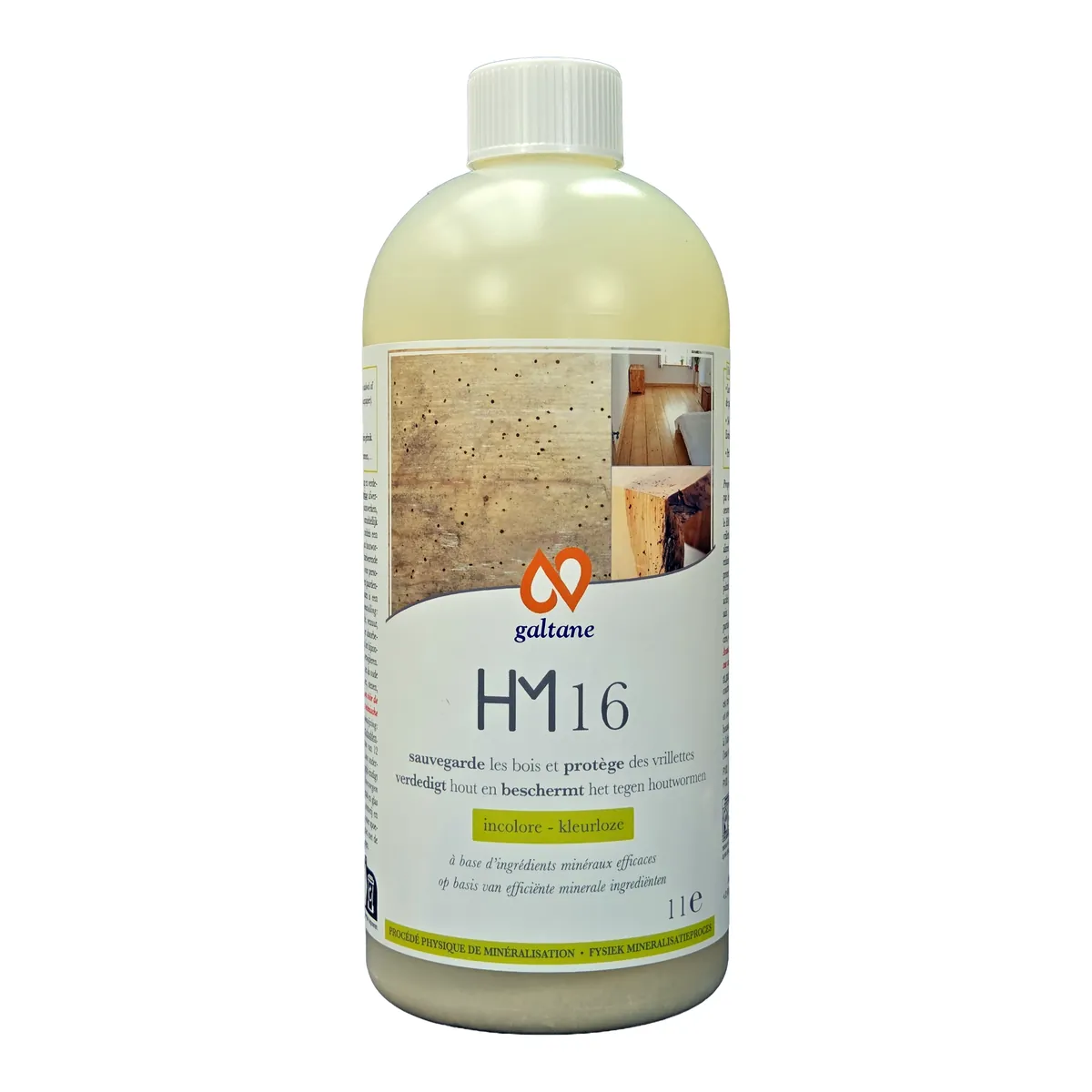
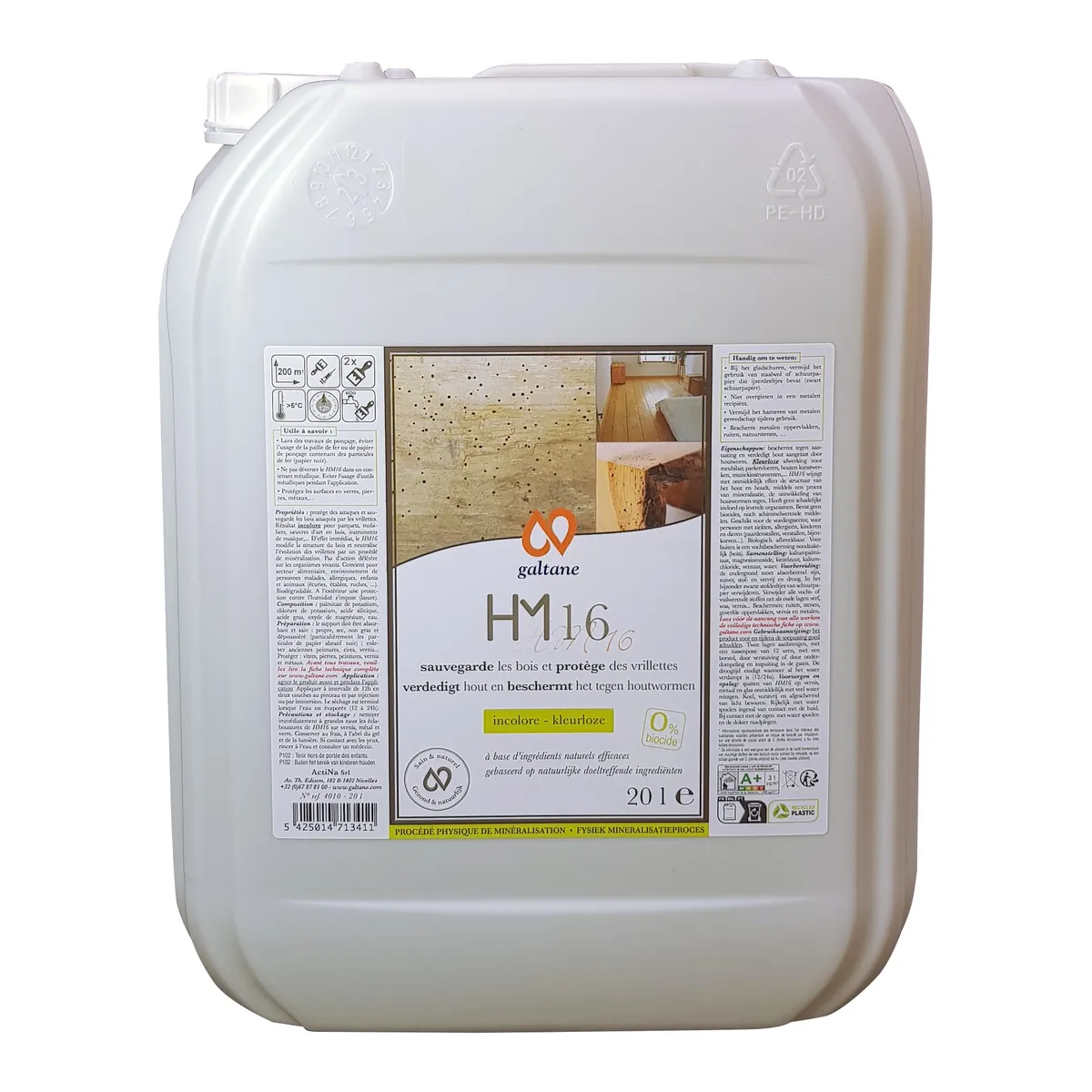
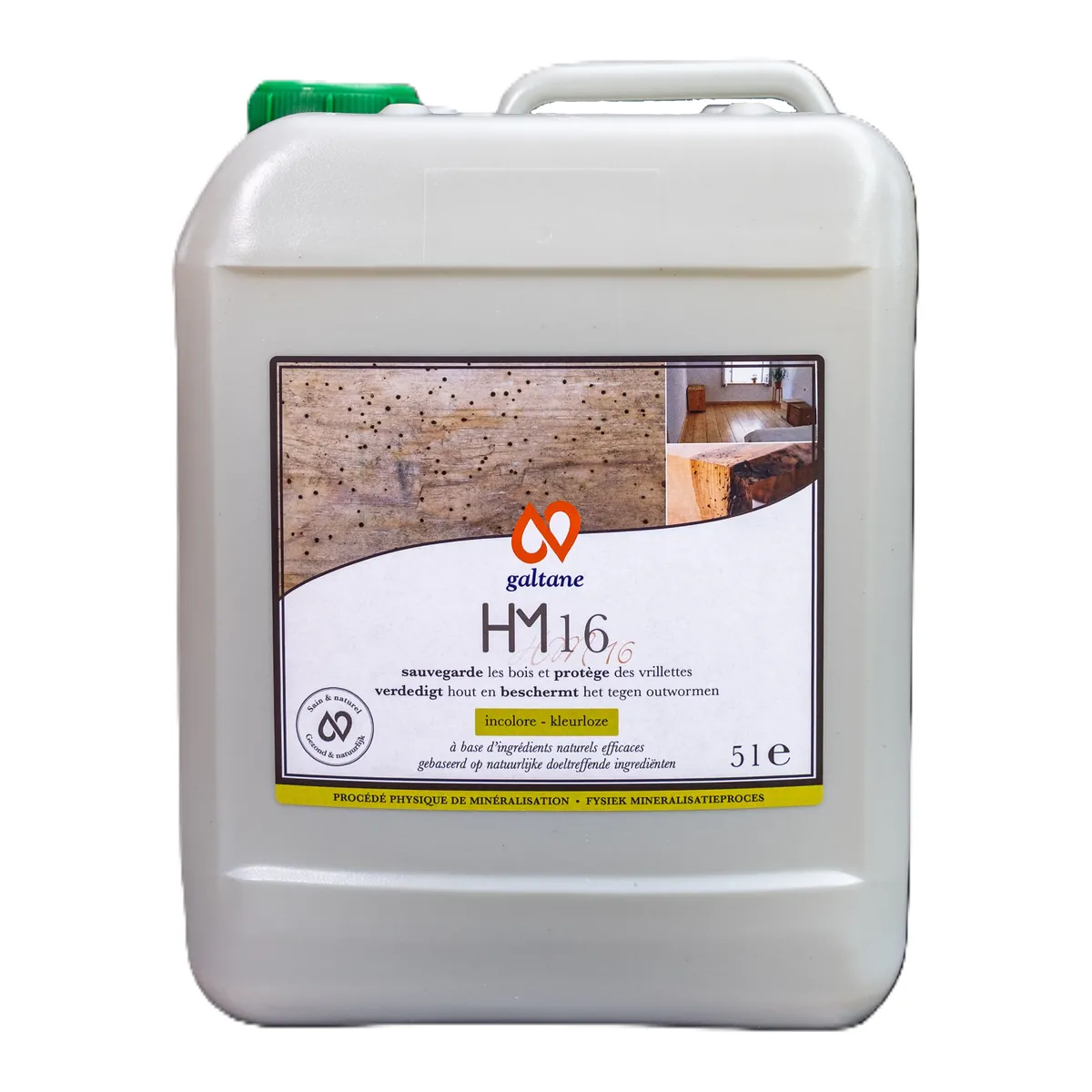

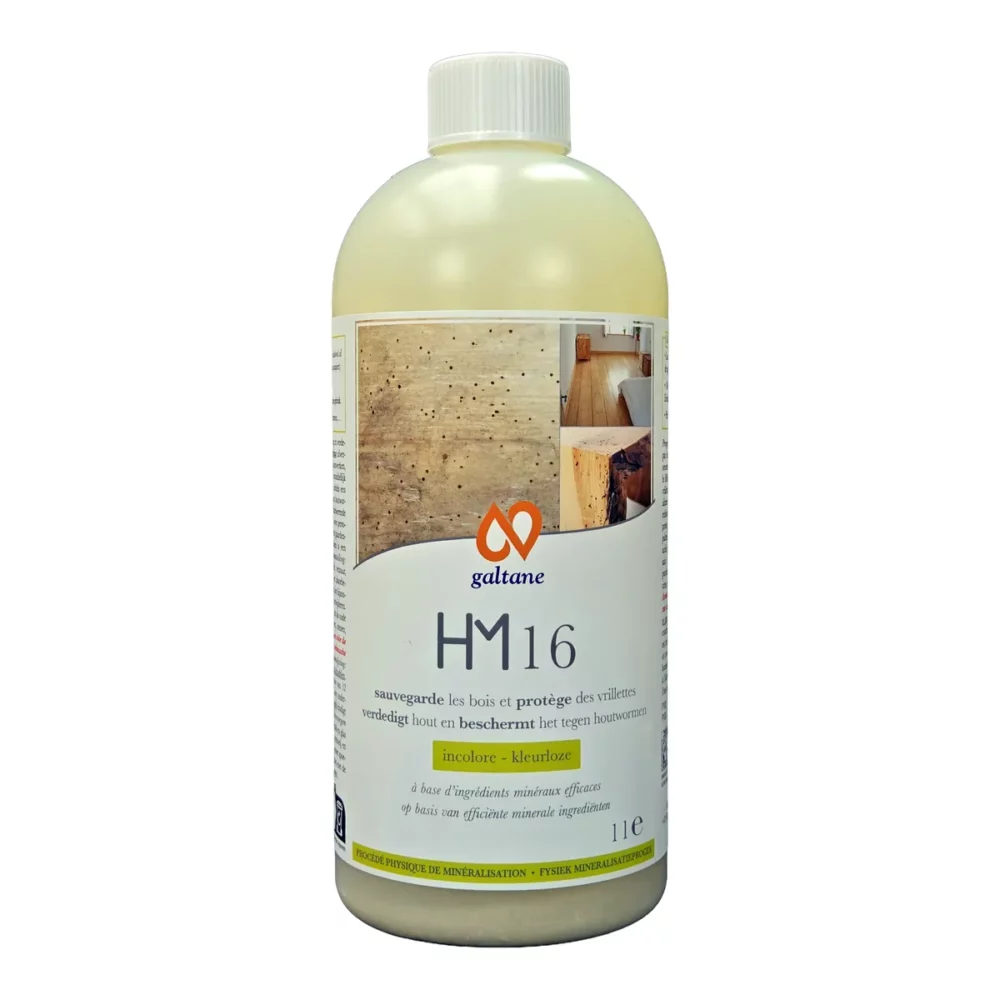
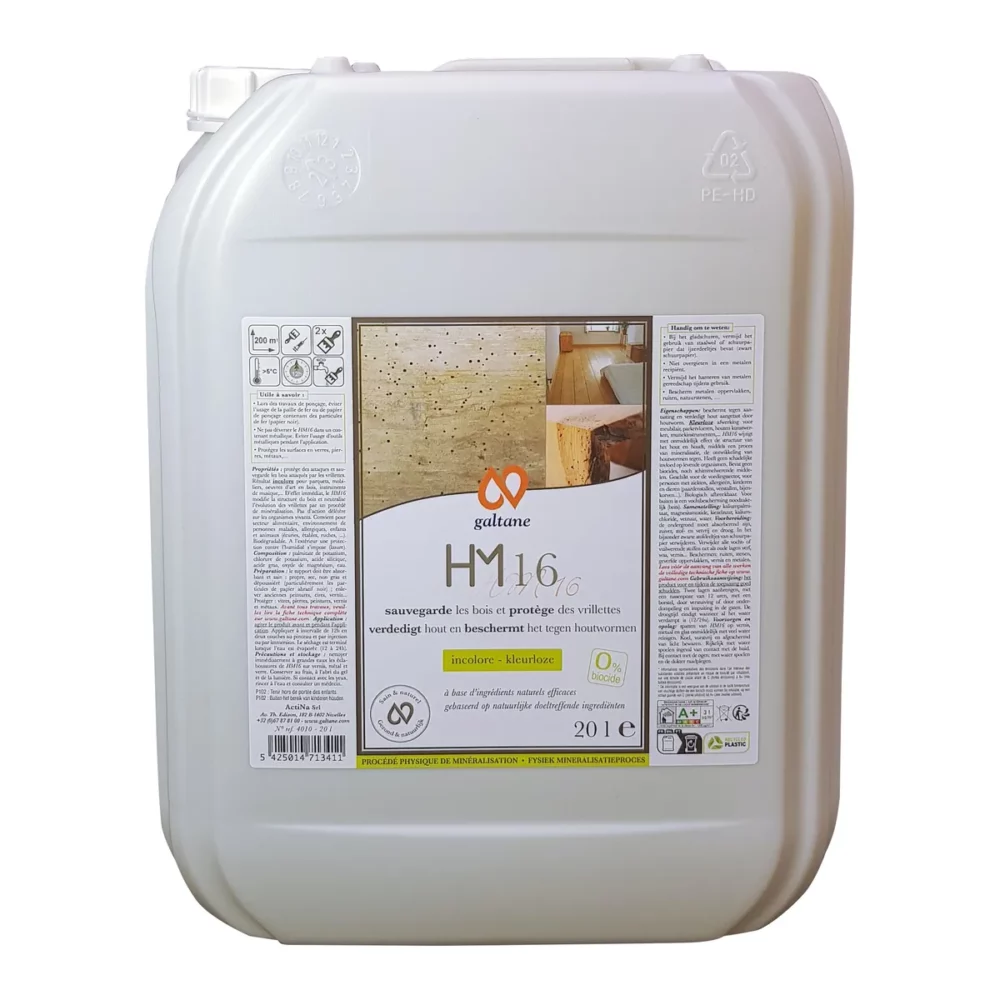
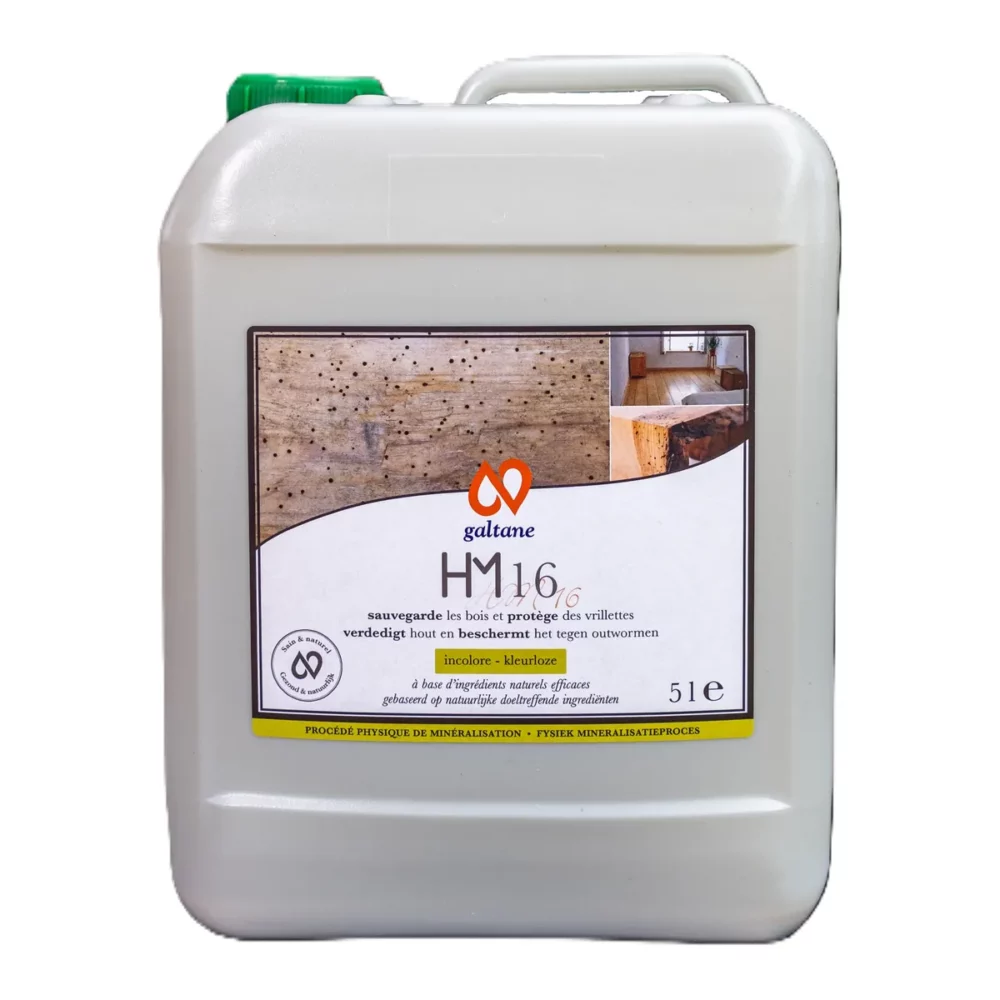
HM16® Ready-to-Use and Preservable
Benefits for Your Home and Materials
- Galtane’s HM16 ensures a high level of protection for human and animal health, as well as the environment (see HM1 composition).
- With HM16, Galtane helps combat ecosystem destruction.
- After more than 35 years of development, we believe a healthy ecosystem supports the connection between humans and the economy.
- We fight against the destruction of animal and plant species.
- To create healthy indoor environments, nature works with us, and we work with it.
- We support regenerative economic models.
Additional details
Good to know
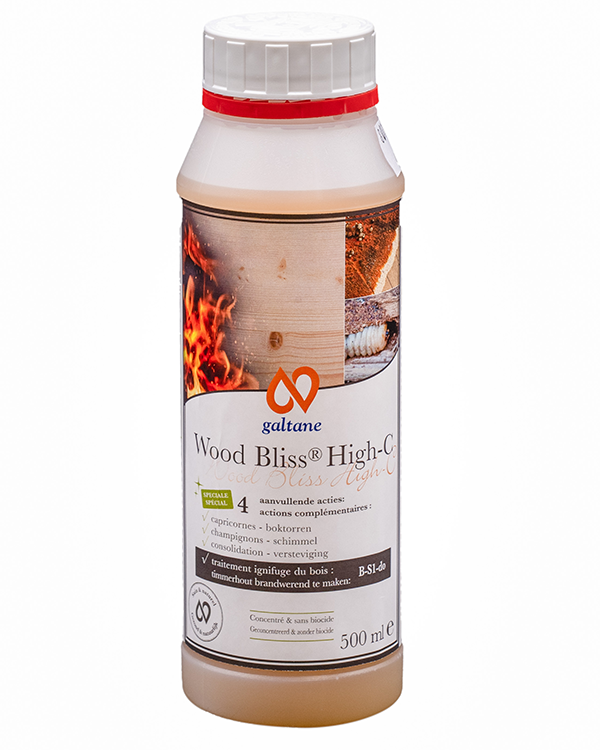
Due to its high alkalinity, a more or less significant change in shade is observed (oak, chestnut…). Do preliminary tests! For a colorless treatment (floors, furniture, frames…), see HM16® ref. 4010. Wear gloves and protect your eyes. Protect metal surfaces, glass (windows, glasses… irreversible stains), natural stones, aluminum, lacquered surfaces, floors… In case of splashes, rinse immediately and thoroughly with water.Which product to choose between HM16®, Wood Bliss®, and Wood Bliss® High-C?
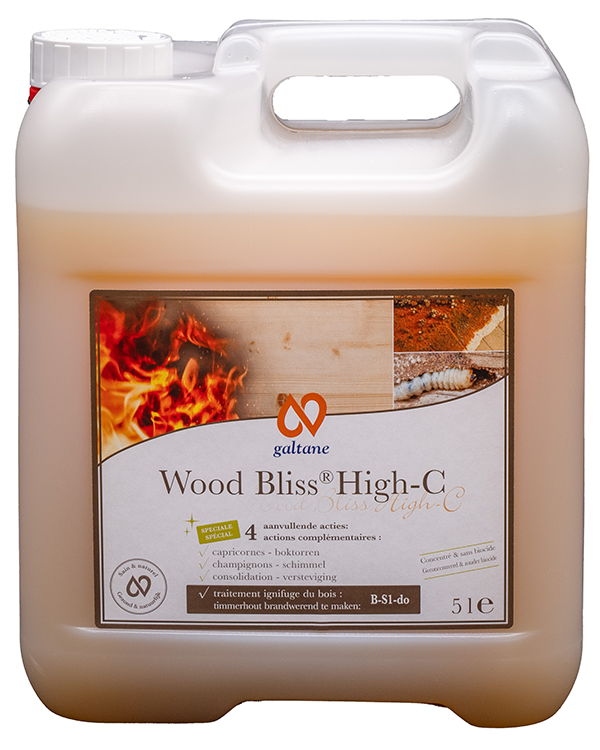
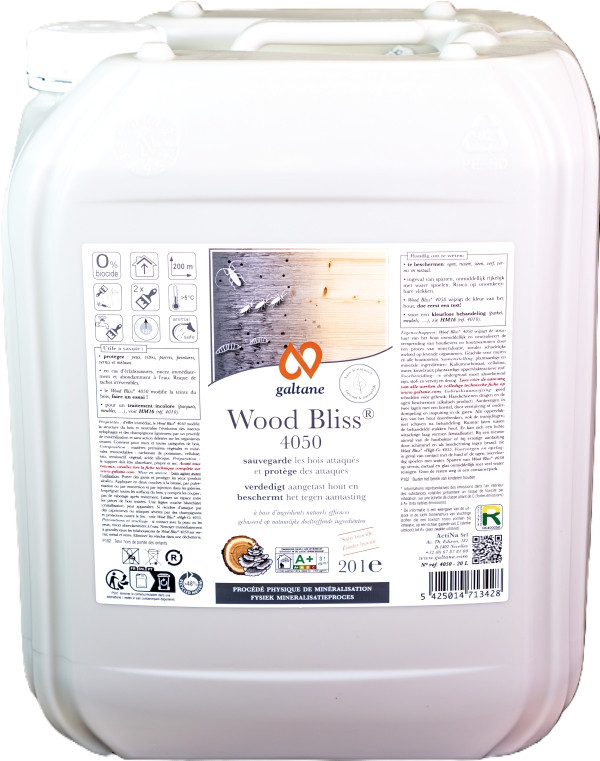
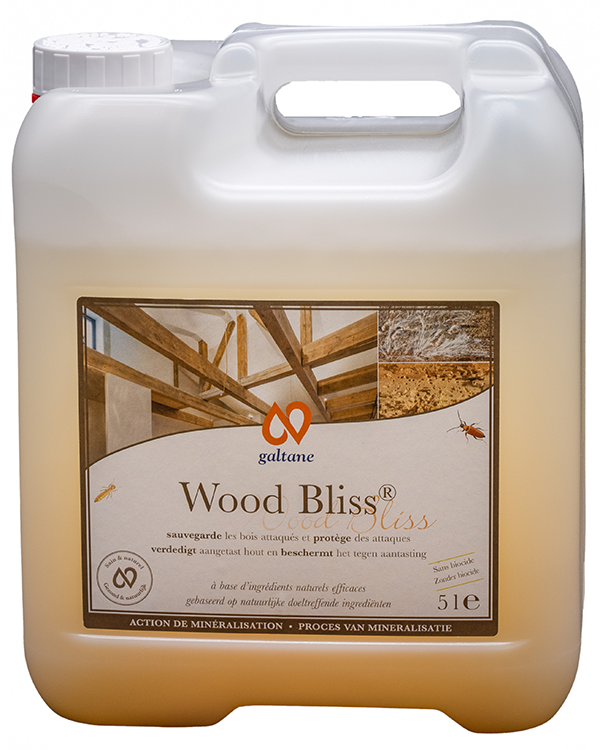
The question to ask is: “is it important to keep the wood’s shade?” If yes, then opt for HM16®. HM16® is a preventive and curative solution limited to woodworms. Woodworms are wood-boring insects that make flight holes of +/- 1mm in diameter. These are often the wood-borers you will find in furniture and floors. HM16® will not change the color of the wood. If no, then opt for Wood Bliss®. Wood Bliss® has a complete spectrum of action. In case of recurrence or action against house longhorn beetles, finish by injecting Wood Bliss® High-C into the wood. For dry rot, finish the treatment with Wood Bliss® High-C by brushing. This includes new joists placed in masonry. Special care should be given to end grain: the cuts.Properties
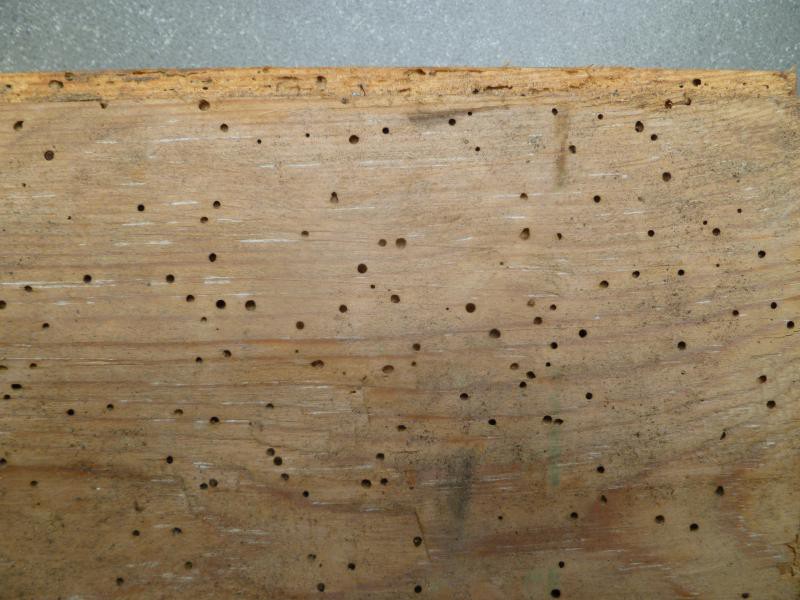
The insects found in timber primarily belong to either the order Anobiidae, Anobium punctatum: the common furniture beetle; or the order Coleoptera, Hylotrupes bajulus: the house longhorn beetle; or the order Isoptera, Mastotermitidae, Rhinotermitidae, Termitidae: the termite. In wood, the house longhorn beetle (Hylotrupes bajulus) forms exit holes of +/- 0.5 cm, while the common furniture beetle forms exit holes of 1 to 2 mm.
HM16 specifically targets treatment against Anobium punctatum: the common furniture beetle.
Good to Know
- Caution: Due to its high alkalinity, a more or less significant color change may occur on acidic woods (oak, chestnut, Douglas fir, etc.). Always perform preliminary tests!
- For a colorless treatment (hardwood floors, furniture, frames, etc.), see Galtane’s HM16 ref. 4010
- The brands: Wood Bliss®, Wood Bliss® High-C, and HM16® are registered trademarks of Actina – Galtane. All texts for Galtane products are subject to current copyright and intellectual property laws. All texts, illustrations, and other content are the property of Actina srl and are protected by reproduction rights.
Technical specifications
| Coverage | 10 m²/L |
|---|---|
| Coats | 2 |
| Drying time | 24h |
| Packaging | Recycled Plastic |
| Pack size | 500 ml, 1 L, 5 L, 20 L |
Any questions?
Related products
-
 33,30 € – 241,10 €Price range: 33,30 € through 241,10 €Select options This product has multiple variants. The options may be chosen on the product page
-
 13,50 € – 254,90 €Price range: 13,50 € through 254,90 €Select options This product has multiple variants. The options may be chosen on the product page
-
 34,90 € – 80,20 €Price range: 34,90 € through 80,20 €Select options This product has multiple variants. The options may be chosen on the product page
-
 17,00 € – 101,89 €Price range: 17,00 € through 101,89 €Select options This product has multiple variants. The options may be chosen on the product page
-
 33,30 € – 241,10 €Price range: 33,30 € through 241,10 €Select options This product has multiple variants. The options may be chosen on the product page
-
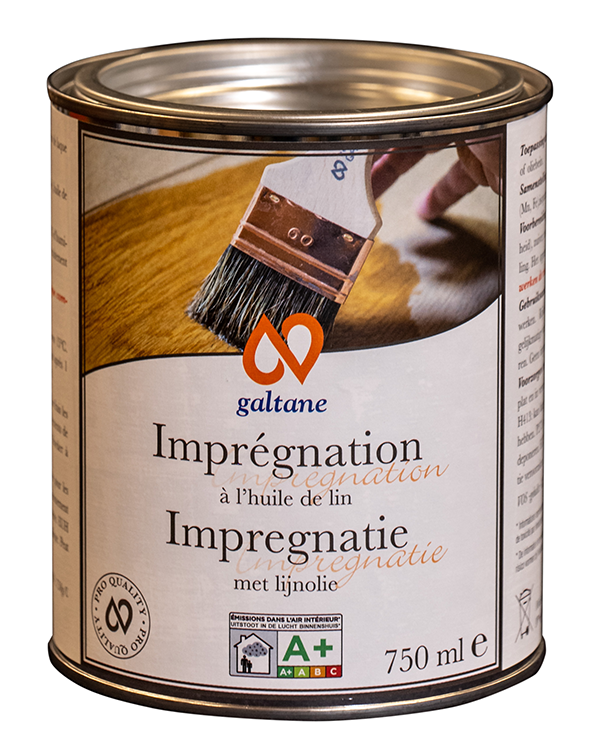
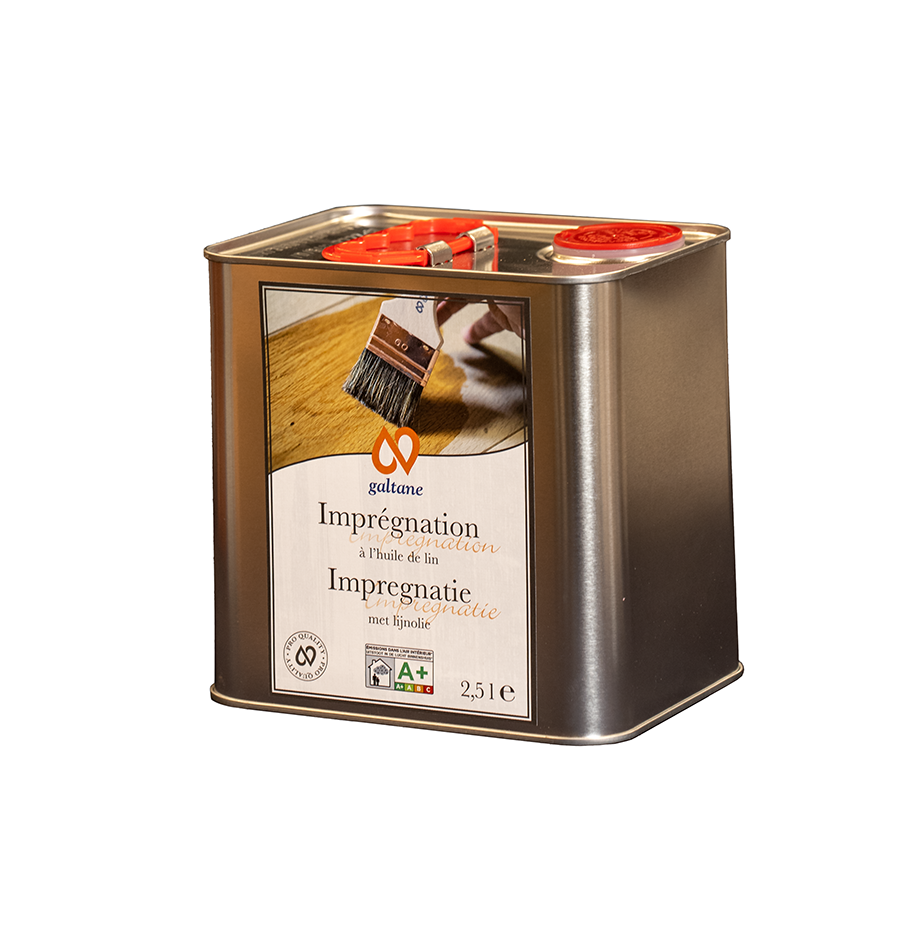 30,79 € – 267,20 €Price range: 30,79 € through 267,20 €Select options This product has multiple variants. The options may be chosen on the product page
-
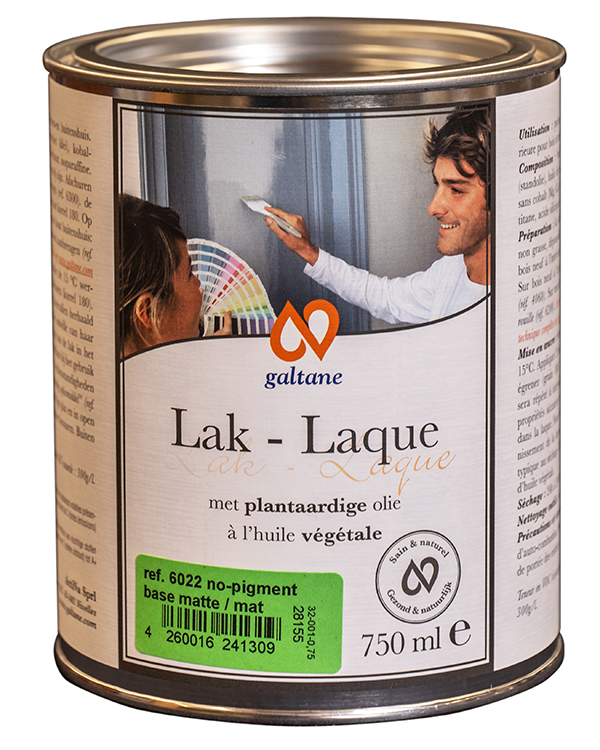
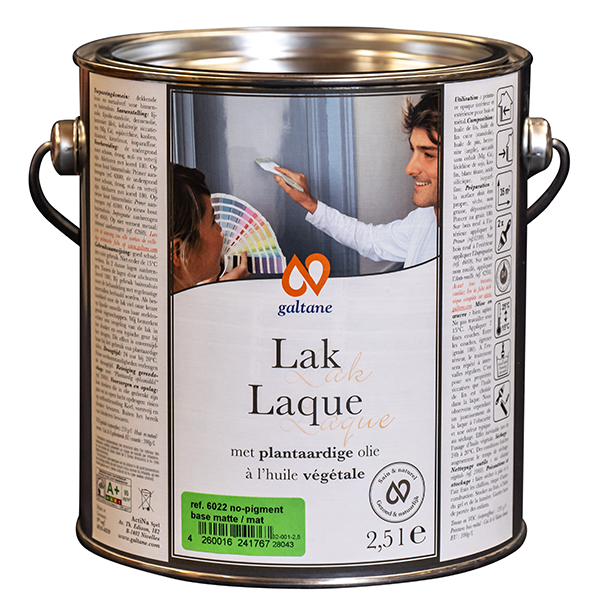 46,60 € – 113,59 €Price range: 46,60 € through 113,59 €Select options This product has multiple variants. The options may be chosen on the product page
Learn More
What are wood-boring insects?
Wood-boring insects find the nutrients they need to live in wood by degrading cellulose, lignin, or starch. At this stage, the insect is only a wood-boring larva. This larva will live in the wood for 1 to 5 years, or even 10 years. It then metamorphoses into an adult insect, exits the wood through an exit hole, and no longer feeds, but reproduces by laying eggs (40 to 100) in the wood’s cracks. The adult insect lives for only about 20 days. The insects found in timber mostly belong to the order Coleoptera (common furniture beetles, house longhorn beetles) or Isoptera (termites). In wood, the house longhorn beetle (Hylotrupes bajulus) forms exit holes of +/- 0.5 cm, while the common furniture beetle forms exit holes of 1 to 2 mm.
Are common furniture beetles infesting your woodwork? How can you non-toxically combat wood common furniture beetles?
How to identify and combat woodworms and common furniture beetles?
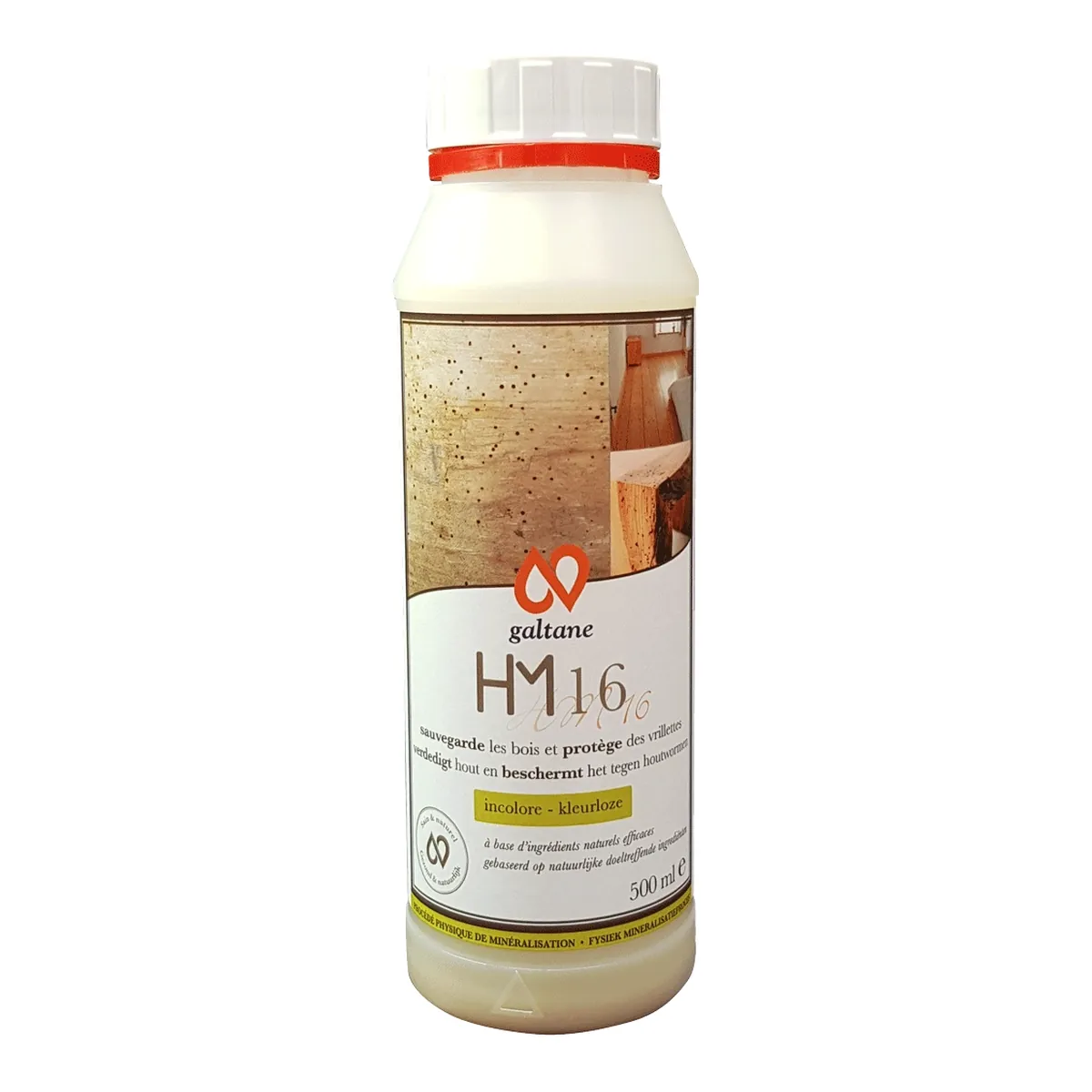
- If you see exit holes with a diameter of +/- 1 mm and wood dust, it means it’s affected by common furniture beetles, and you should treat it with Galtane’s HM16®.
- HM16® is an effective, natural, and non-toxic solution that works as a preventive and curative measure against common furniture beetle type woodworms.
- Galtane’s HM16® is the effective natural treatment for woodwork, furniture, and parquet floors against common furniture beetles.
- HM16® is a colorless treatment against common furniture beetles. HM16®, against common furniture beetles, does not alter the wood’s color; it treats and protects it.
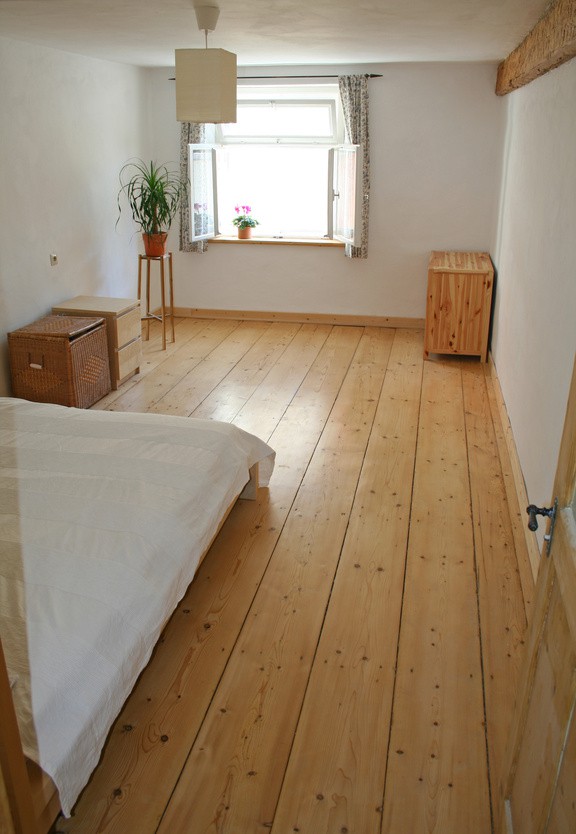
- Colorless preventive and curative treatment for all interior woodwork: furniture, parquet floors, windows, wooden art objects, musical instruments, … against small insects of the Anobiidae family (wood-boring).
- Product designed using a globally patented process.
- It should also be noted that thanks to this innovative principle, HM16®’s action increases over time and does not diminish, unlike most products. This treatment is based on over 35 years of experience.
How does HM16® work?
Galtane HM16® is a natural, non-toxic wood protection product, formulated from renewable plant-based raw materials. HM16® eliminates, down to its penetration depth and through a crystallization effect, all the wood’s nutrients that common furniture beetle type insects already present in the wood feed on. Their living conditions are altered such that their growth is inhibited.
Is HM16® a toxic treatment?
Contains no suspected toxicological components. Designed using a globally patented process. Using Galtane HM1 helps avoid any use of pesticides, insecticides, and other toxic products.
Where can HM16® be used?
Galtane HM16® can even be used in protected natural areas. Special features: – HM16® emits no toxic substances and can therefore be used without reservation in enclosed spaces! Due to its harmlessness, HM16® is highly recommended in premises for people with allergies or asthma, young children, and children with respiratory allergies.
- The preparation, application, and disposal of the product require no special precautions. Galtane HM16® is biodegradable!
- In the food sector, Galtane’s HM16® is a neutral product. Even in direct contact with food products, there is no risk of intoxication!
- HM16® is not even toxic to bees. Therefore, there is no danger to these useful and very vulnerable insects! It can also be useful for treating woodwork in stables, farms, horse stalls, chicken coops,
- HM16® allows for diffusion and thus the necessary moisture exchange.
- HM16® does not flake and can be post-treated if necessary.
Learn more about eco-friendly wood mineralization: Galtane offers natural and sustainable innovation
How does wood treatment by mineralization with HM16® work?
Wood treatment by mineralization is an innovative eco-friendly technique that strengthens and protects wood by imparting mineral properties. This method aims to improve the wood’s durability, resistance to pests and fungi, and stability, while reducing the need for traditional chemical biocides.
Here is how this natural and ecological process works:
Mineralization consists of impregnating the wood with mineral or silicate-based solutions. These substances crystallize in and with the wood fibers to create mineral deposits that modify the internal structure of the material. The treated wood becomes more resistant to moisture, insects, and fire.
Its advantages include:
- A lifespan of >50 years.
- An ecological solution without harmful chemicals.
- Better dimensional stability of the wood.
Steps of the mineralization process
A. Wood preparation
- The wood is carefully prepared:
- Cleaning to remove any dirt or mold.
- If necessary, the wood can be sanded or previously treated against active infestations.
B. Impregnation with HM16® mineral solution
- The wood is dipped or injected with a mineral-based solution of Wood Bliss® and Wood Bliss® High-C:
- Immersion: The wood is dipped in tanks containing the solution to ensure uniform penetration.
- Injection: For thick or complex pieces, the solution is injected under pressure into the wood pores.
- Spraying: Method used for surface applications or thin wood.
Mineralization reaction
- Once the HM16® solution is applied, a mineralization reaction occurs between the minerals and the wood fibers.
- The minerals form solid deposits in the pores and around the fibers.
- This crystallization strengthens the wood by making it denser and more waterproof.
Drying and stabilization
- After drying, the wood is ready for use with improved properties.
Increased resistance
- Resistance to insects: Wood-boring insects are deterred by the mineralized texture, which is less nutritious for them.
- Resistance to fungi: Mineralization reduces the moisture available in the wood, making conditions unfavorable for wood-destroying fungi.
Long-term durability
- The treated wood is protected against natural degradation, which extends its lifespan.
Advantages of mineralization treatment
- Ecological: The solution used is generally non-toxic, unlike traditional chemicals.
- Increased durability: this type of application is sufficient to protect the wood over long periods.
- Versatility: Applicable to different types of wood (softwoods and hardwoods).
- Improved natural resistance: offers integrated protection against multiple factors (insects, fungi, moisture, fire).
Limits of mineralization treatment:
- Initial cost: This treatment can be more expensive than toxic chemical methods.
- Treatment time: The process can be longer due to the drying and stabilization steps.
- Aesthetic modification: Mineralization can slightly alter the natural appearance of the wood (change in shade).
Estimated lifespan:
- Protection is permanent
- Unlike chemical or autoclave treatments that can fade over time, mineralization with Wood Bliss® and Wood Bliss® High-C structurally modifies the wood by depositing solid minerals. This transformation is durable and does not require regular reapplication.
- Once correctly applied, the treatment can protect wood for several decades >50 years, or even the entire lifespan of the structure.
Maintenance required:
- Mineralized wood does not require specific maintenance to maintain its protection.
- In case of wear (for example, cracks, knocks in the wood, mechanical erosion, prolonged exposure to aggressive agents), a check and a complementary surface application can be considered.
Long-term advantages:
- Economical: No repeated treatment or frequent maintenance, which reduces costs in the long term.
- Ecological: this type of durable application minimizes the use of chemicals.
- Secure: Ensures reliable protection against biological and environmental aggressions.
Tips to maximize durability:
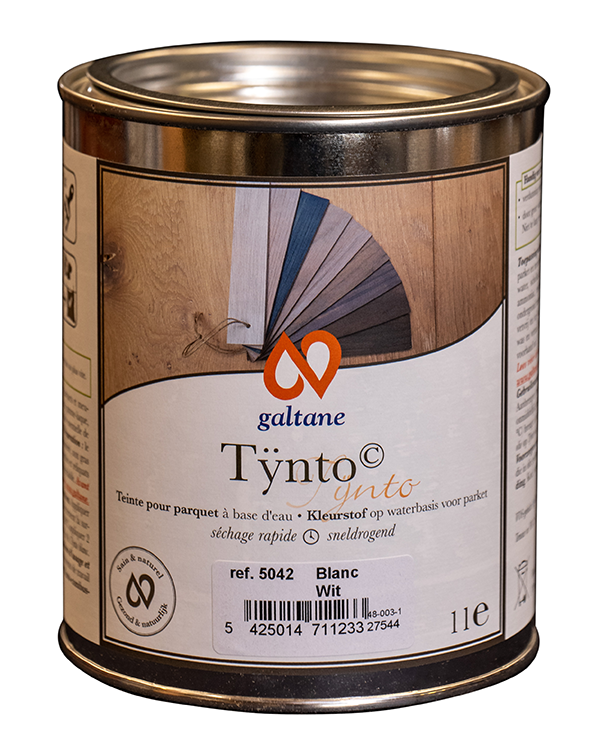
- Preventive treatment: Apply vegetable oils such as Galtane wood stains, or Galtane Oil Lacquer to improve resistance.
- Regular maintenance: Inspect and maintain wood exposed to weather or moisture.
- Ventilation: Install wood in well-ventilated environments to avoid stagnant moisture.
- Insulation: Limit direct contact with the ground to reduce the risk of termite attacks or rot.
Conclusion
- Treating and preserving wood is essential to ensure the longevity and safety of your structures.
- Whether through natural preventive treatments or ecological and innovative curative methods like mineralization, each solution offers tailored protection.
- By choosing ecological and sustainable techniques, you preserve not only your heritage and your health but also the environment.
The brands: Wood Bliss®, Wood Bliss® High-C, and HM16® are registered trademarks of Actina srl – Galtane.